

Aussie scientists warn of ‘catastrophe’ after discovery at bottom of ocean
Google News
Australian scientists have investigated the forces that create some of the world’s densest and coldest water. Although Antarctic Bottom Water is known in just four remote locations, its flow impacts weather patterns all around the world.
The Queensland University-led team focused their investigation on the water at Cape Darnley, located on the west side of MacKenzie Bay.
Its lead author Dr David Gwyther found that its production is finely balanced by two competing systems.
Worryingly, they’re being altered by climate change, and this could dramatically alter the weather in faraway places like Northern Europe and Africa.
To understand the role ocean currents play in maintaining temperature, Gwyther compares the United Kingdom and Canada, which are on roughly the same latitude but have very different climates.
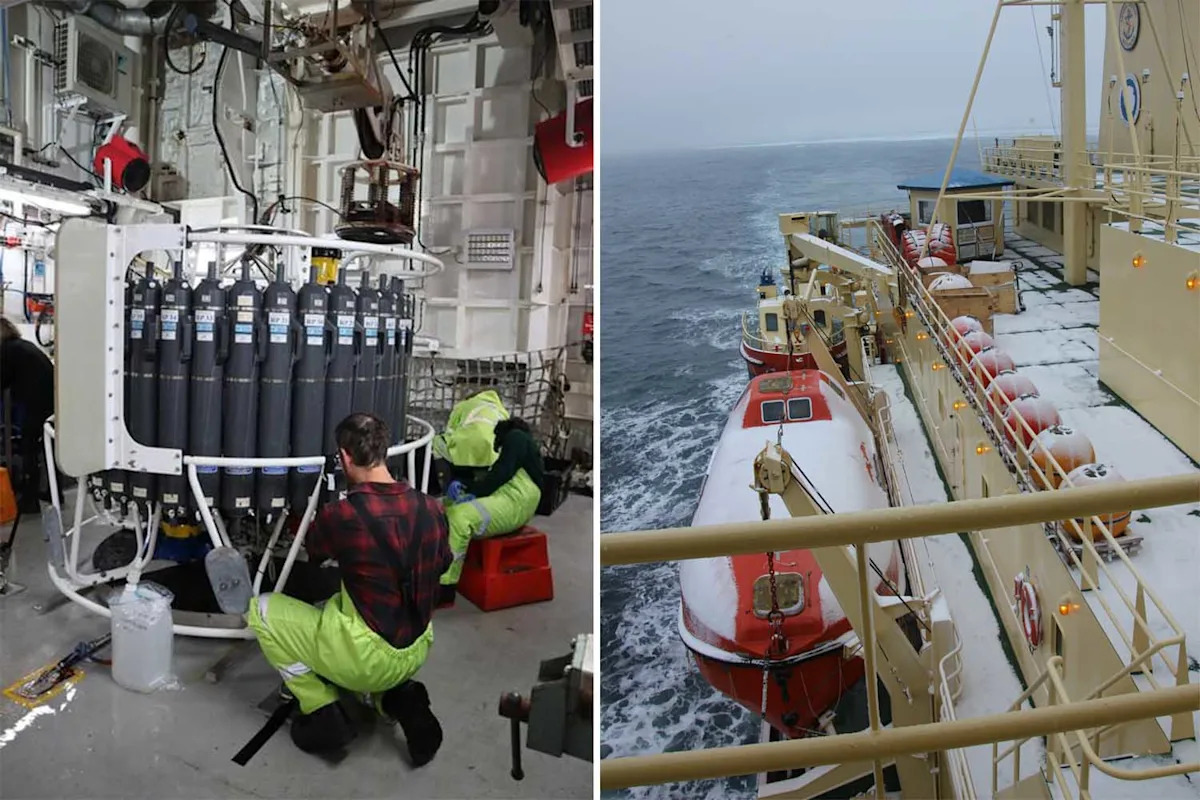
Researchers are only just beginning to understand the processes that create the dense water at the bottom of the ocean. Source: R/V Nathaniel B. Palmer
“The weather in Canada, especially in winter, is much colder, and that’s because of the movement of warmer water across the ocean,” he told Yahoo News.
“There has been modelling showing that if you interrupt that [process], you get dramatic cooling across Northern Europe, which would be catastrophic, and society would need to adapt very quickly.”
What’s it like at the bottom of the ocean?
Because the conditions are so extreme at the bottom of the ocean in Antarctica, it’s been incredibly hard for scientists to study the region until recently.
“You get these wild-looking, spindly spider crabs, and you have fish with antifreeze in their blood so they can survive in this cold water,” he said.
“And there are elephant seals that can dive down to 1,000 metres… there’s a surprising amount of life down there.”
For 12 years, it’s been known that there was Antarctic Bottom Water at Cape Darnley, but scientists didn’t understand how sensitive its formation was.
Cape Darnley is just one of four known locations where this extremely cold and dense water is produced. Source: University of Queensland
What are the forces that create Antarctic Bottom Water?
Following the publication of the research in the journal Geophysical Research Letters, Gwyther explained what his team had uncovered using modelling of Cape Darnley.
“Meltwater flowing from beneath the Amery Ice Shelf freshens the water flowing northwards to Cape Darnley and suppresses dense water formation,” he said in a statement.
“Conversely, sea ice production in the nearby Mackenzie Polynya region between the Amery Ice Shelf and Cape Darnley increases salinity and strengthens dense water formation.
“These two systems influence Cape Darnley’s dense water formation in opposite directions.
The finely balanced systems that produce Antarctic Bottom Water could be altered by climate change. Source: University of Queensland
Gwyther added that both of these processes are susceptible to climate change, and that increased ice shelf melt, or reduced sea ice growth, could result in changes to the water’s density.
“If the balance were to shift through more melting ice or a reduction in polynya activity, we could see major changes in how much dense water forms and flows into the global ocean,” he said.
Love Australia’s weird and wonderful environment? 🐊🦘😳 Get our new newsletter showcasing the week’s best stories.
Google News
Source link

