The Science of Micro-Habits:Why 1% Daily Shifts Yield Huge Results The Science of Micro-Habits: Why 1% Daily Shifts Yield Huge Results
We have all been sold the grand illusion of the overnight transformation. We tell ourselves that to change our lives, we need sweeping, monumental effort—a radical diet overhaul, a grueling two-hour workout daily, or a complete digital detox starting tomorrow morning.
Yet, by week three, the initial surge of motivation vanishes. The gym membership sits unused, the unread books stack up on the nightstand, and frustration sets in.
The failure lies in human biology. Grand ambitions trigger our brain’s internal threat mechanisms, creating friction, cognitive fatigue, and inevitable burnout. Real, permanent transformation rarely arrives in a single dramatic leap. Instead, it is built quietly through micro-habits—tiny, nearly effortless actions that leverage 1 percent daily improvements to yield extraordinary long-term results.
The Math Behind the 1% Shift The Science of Micro-Habits:Why 1% Daily Shifts Yield Huge Results
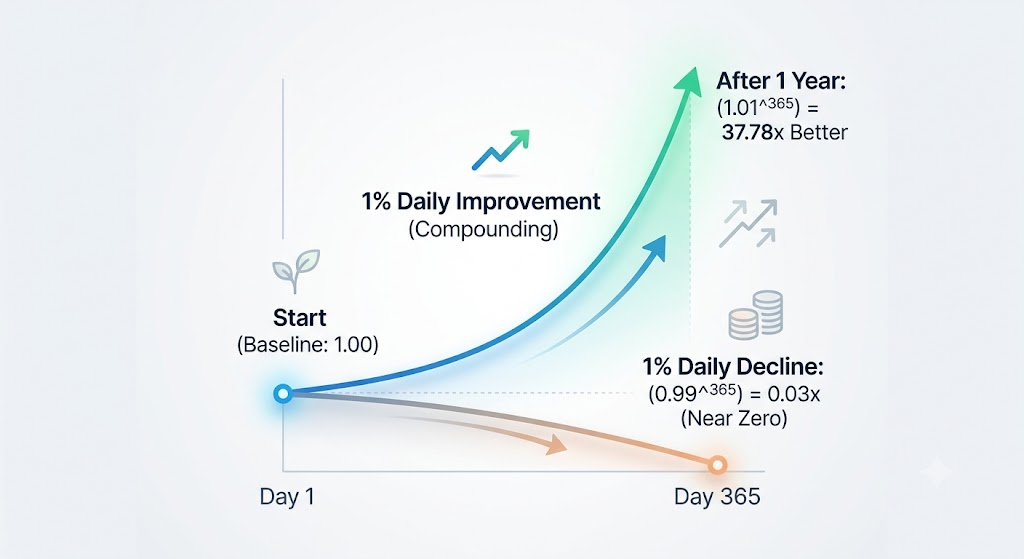
The principle of marginal gains is deceptively simple: if you get 1 percent better at something each day for a year, you do not simply end up 365 percent better. Thanks to compound interest, the mathematical output is far more dramatic: getting 1 percent better daily for 365 days leaves you nearly 38 times better off by the end of twelve months. Conversely, letting your habits decline by 1 percent daily degrades your baseline down to near zero.
The challenge is that human perception is non-linear. In the first few weeks, a 1 percent improvement feels practically invisible. Reading one page of a book a night does not make you wiser by Friday. Doing five wall push-ups during a work break does not instantly tone your upper body.
Author James Clear calls this period the Plateau of Latent Potential. It is the delta between what you expect to happen and what is actually occurring below the surface. During this phase, work is not being wasted; it is being stored, waiting to break through once the compound curve takes off.
The Neuroscience: Why Tiny Actions Rewire Your Brain
Why do micro-habits succeed where high-intensity resolutions fail? The answer lies in how our central nervous system processes change and effort.
Bypassing the Amygdala
When you decide to execute a massive, disruptive change, your brain’s fear center—the amygdala—interprets the sudden disruption as a threat. This triggers an underlying stress response, releasing cortisol and activating behavioral resistance. Micro-habits are intentionally sized to fly beneath your brain’s radar. Because an action like stretching for 30 seconds or drinking a single glass of water requires almost zero willpower, the amygdala remains quiet, allowing you to execute without mental friction.
Offloading to the Basal Ganglia
The Science of Micro-Habits: Why 1% Daily Shifts Yield Huge Results

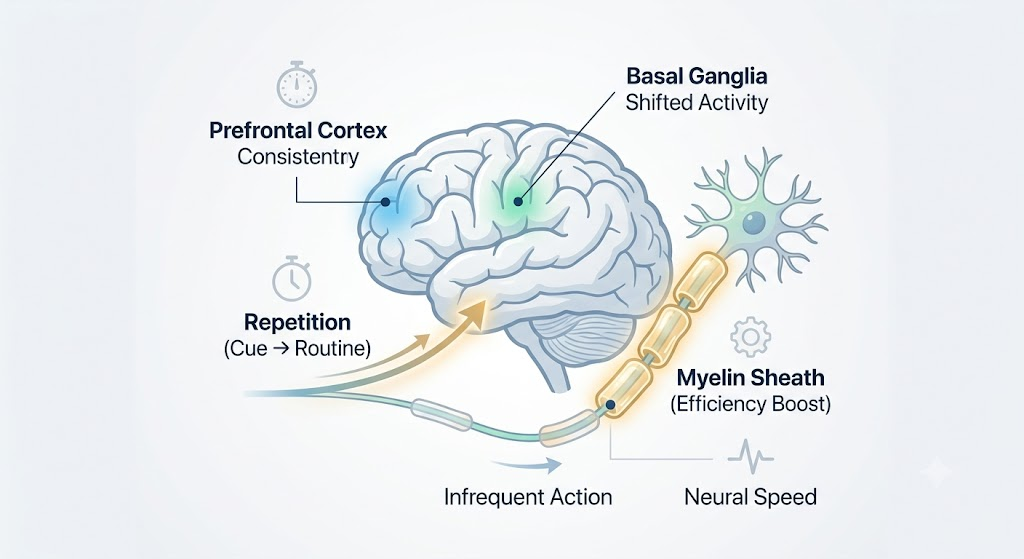
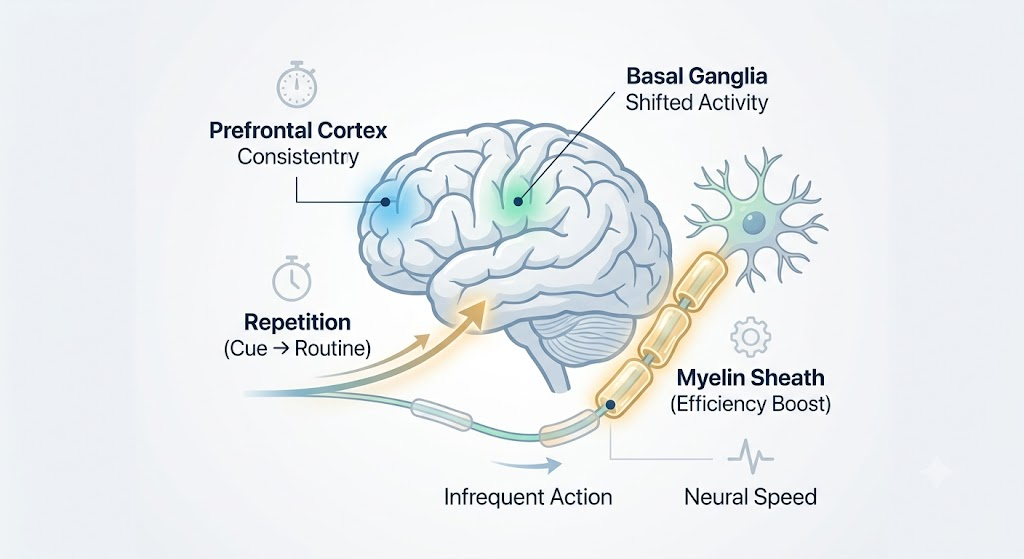
Your prefrontal cortex is the executive center of your brain—responsible for complex planning, decision-making, and self-control. However, it depletes quickly under stress and fatigue. The basal ganglia, located deeper in the subcortical structure, acts as your brain’s autopilot engine.
When an action is repeated consistently in response to a specific cue, the brain shifts control from the energy-hungry prefrontal cortex to the efficient basal ganglia. Micro-habits accelerate this transfer because their low friction enables near-perfect consistency.
Myelination and Hebbian Learning
Neuroscientists frequently quote Hebb’s Axiom: Neurons that fire together, wire together. Every time you perform a behavior, neural circuits fire in sequence. Repeated firing triggers oligodendrocytes to wrap the active axon in myelin—a fatty insulation layer that speeds up electrical signal transmission.
What dictates myelination is not the duration or intensity of an action, but its frequency. Flossing one tooth every single day builds stronger neural pathways than flossing all your teeth once a month.

3 Practical Frameworks to Build Unstoppable Micro-Habits
Understanding the science is only half the equation; applying it systematically is what produces results. Here are three proven tactics to integrate micro-habits into your routine.
- The Two-Minute Rule
Whenever you want to build a new habit, scale it down until it takes two minutes or less to perform.
Instead of trying to read 30 pages a night, the micro-habit approach is to read one page.
Instead of aiming to meditate for 20 minutes, the micro-habit approach is to take three conscious breaths.
Instead of forcing yourself to go to the gym for an hour, the micro-habit approach is to simply put on your running shoes.
The point is not to limit yourself forever to two minutes, but to master the art of showing up. A habit must be established before it can be expanded.
- Strategic Habit Stacking
The fastest way to form a new neural pathway is to anchor it to an established one. Identify a routine you already perform without thinking every day, then stack your micro-habit directly onto it. The formula is simply taking your current habit cue, performing your new micro-habit, and experiencing an immediate sense of completion.
For example, after you pour your morning coffee, you can write down your top priority for the day.
Another example is after you brush your teeth at night, you can do two simple stretches.

- Identity-Based Shifts
True habit modification is not about what you want to achieve; it is about who you wish to become. Every action you take is a vote for the type of person you believe you are.
When you complete a micro-habit, you provide your brain with immediate tangible evidence of your identity. Writing one sentence daily makes you a writer. Saving five dollars a week makes you an investor. Over time, your self-conception shifts to align with your actions, eliminating the internal conflict that typically undermines long-term progress.
The traditional approach focuses on rapid outcomes, relies heavily on motivation and willpower, leads to high intensity with sporadic execution, and triggers brain resistance via the amygdala.
The micro-habit approach focuses on identity and trajectory, relies on low friction and automation, achieves daily consistency with manageable effort, and bypasses friction to build neural myelin.
The Science of Micro-Habits: Why 1% Daily Shifts Yield Huge Results
The Path Forward: Consistency Over Intensity
The ultimate goal of personal optimization is not to overhaul your life overnight, but to build a reliable engine of continuous improvement. When you reduce the scope of your goals down to microscopic, repeatable actions, failure becomes almost impossible.
Stop waiting for a wave of motivation or a clean slate on January 1st. Choose one tiny, 1 percent adjustment you can make today—one that takes less than 120 seconds. Let the mathematics of compounding and the biology of neuroplasticity do the heavy lifting in the background.
The Science of Micro-Habits: Why 1% Daily Shifts Yield Huge Results
THANKS AND WRITTEN BY
KAMAL KISHORE
FIND SUPER DEALS


