
Breaking News, World News, US News, Sports
In 1975, a movie filmed in Martha’s Vineyard made people afraid to go into the water. Today, a real animal in Martha’s Vineyard is making people afraid to go outside. “It’s gotten to the point now that grandparents are not allowing their grandchildren to come visit them,” said Sam Telford.
“We stay in the apartment,” said Ben DeForest. “You just don’t know; these things are out there. It’s gone from a 20-foot great white shark, to an apex predator that can fit on the tip of a needle.”
We’re talking about ticks.
Ticks have been giving us diseases for centuries, including Lyme disease, babesiosis, ehrlichiosis, and Rocky Mountain spotted fever. But this year is remarkable. Emergency room visits for tick bites are the highest they’ve been in nearly a decade, as ticks spread into new parts of the country — and to top it off, a new horror has hit the headlines: Alpha-gal syndrome. One tick bite can make you violently allergic to meat: beef, pork, veal, lamb, venison, rabbit, everything but seafood and poultry.
Adriana Stimola lives on Martha’s Vineyard, where Alpha-gal is an epidemic. “About five hours after having a hamburger on the beach at midnight, I wake up and I have a rash, I have some swelling in my hands, and I’m in gastric distress,” she said.
Her children got it, too, and her husband. “He had a burger, and at midnight woke up and shot out of bed,” she recalled. “Pretty quickly he was like, ‘My mouth feels weird. My lips are swelling.’ And I just said, ‘Get in the effing car!'”
Alpha-gal reactions can include anaphylactic shock, where your airways close up. Some people become allergic to dairy products, too, or even to the aroma of meat. Some react to things that contain animal products, like marshmallows, Doritos, and medicine capsules.
Stimola says it has even affected going to a friend’s house for dinner: “I feel that really deeply,” she said. “It kind of hurts to say, ‘Oh, I can’t eat that,’ ’cause I miss that kind of connection where I’m eating food that other people love.”
CBS News 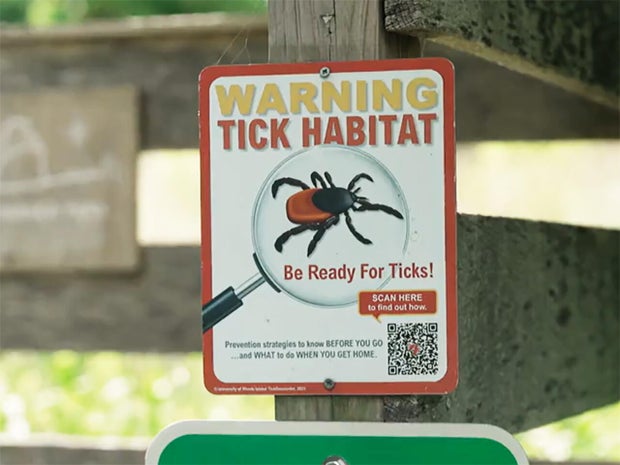
Ben DeForest grew up on Martha’s Vineyard, “in the woods, in the water, in the fields, all of that,” he said. “And I don’t go there anymore. I stay on asphalt and concrete.”
DeForest is the owner of the Red Cat Kitchen, where he’s accommodated the Martha’s Vineyard epidemic by creating a special menu. “When you go out to eat, you don’t necessarily feel like explaining your entire medical history to a stranger who’s taking your order,” he said.
He showed us a dish from his “Alpha-gal friendly,” no-red-meat menu: Halibut, parsley, and bull’s blood (“It’s beets”).
Tick-borne diseases
Alpha-gal syndrome, which was discovered in the mid- to-late 2000s, is not brand-new to the country, says Sam Telford, a professor of infectious disease and global health at Tufts University: “Not at all. And in fact, it’s very interesting that it has risen to national prominence because of places like the Hamptons and Martha’s Vineyard, when in fact people in the South and Midwest have been suffering this all along. Southerners are like, ‘Well, you know, if you don’t have a dog with ticks on it, what kind of dog is that?'”
So, what has changed? “It’s awareness now,” said Telford.
Alpha-gal is short for galactose-α-1,3-galactose, a sugar molecule carried by the lone star tick. And lone star ticks are surging, especially in the Northeast.
Ticks come in small (larva), medium (nymph), and large (adult) sizes.
We went out with Tom Mather (a.k.a. the Tick Guy), a professor of public health entomology at the University of Rhode Island. He gave me socks that have been treated with a chemical called permethrin, that can actually kill ticks. But he still advises to tuck my pants into my socks.
CBS News 
It’s larva season in Rhode Island, and ticks can be found on the underside of leaves. A fuzzy brown “larval bomb” is a teeming cluster of larvae, ready to explode onto any p***ing disturbance.
CBS News 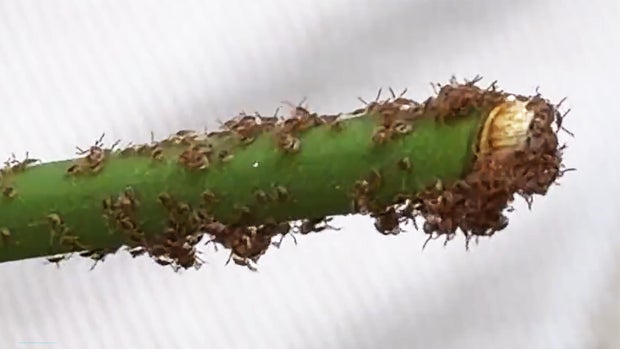
After dragging white flags for a few seconds, the flags were covered in lone star ticks — the Alpha-gal variety. I am potentially one inch away from never being able to eat meat again!
CBS News 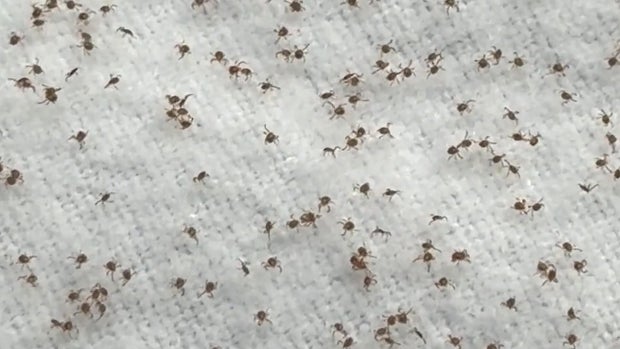
Tick carriers
Any discussion of tick diseases eventually brings up deer. We have a tick problem because we have a deer problem. “The white-tailed deer are the primary breeding ground for lone star ticks, as well as deer ticks,” said Aubrey Stimola Ryan, who treats tick-bite patients at Martha’s Vineyard Hospital, and in her own clinic. “And we have a very large sort of out-of-control deer population here.
“One deer can feed 1,500 ticks per season,” Ryan said. “And one tick can lay 2,000 eggs, one female tick! So, that’s 3 million ticks that are coming off of one deer.”
Sam Telford said, “We don’t want to eradicate deer. We just want to bring them down to a level that is something that the colonists had.”
According to Telford, the public’s aversion to killing deer may be changing: “I’ve worked on trying to get communities to reduce their deer for 40 years now, and Lyme disease wasn’t enough. But now this new syndrome, Alpha-gal syndrome, is stimulating communities to say, ‘Enough is enough. Reducing deer will reduce ticks, and so, let’s go there.'”
Now, not every tick bite gives you a disease; and not everyone with Alpha-gal develops the meat allergy. And even if you do, it may not be a life sentence. “Over time, it seems like it can get better,” said Telford. “You can slowly introduce meat products back into your diet over time, if you don’t get bitten by ticks again.”
Aubrey Stimola-Ryan has advice along those lines: “Spraying your skin, spraying your clothes. When you come inside, take your clothes off and throw them in the dryer for 10 minutes on high. And check yourself for ticks twice a day.”
In particular, Tom Mather suggests checking wherever tight clothing might stop a moving tick: “Your waistband is a good spot, certain cracks and crevices of your groin. Women, their bra straps will stop ticks as well.”
As for Adriana Stimola, life goes on — without meat, and with a philosophical outlook: “We’ve done a lot of damage raising, especially, cattle for our consumption. So, I think maybe it will make us talk about the way we eat meat, how much we eat meat, the way that we raise it, where do we fit in the greater sort of food chain, and reminding us that we are part of a larger system.”
For more info:
- Thomas Mather, director, Center for Vector-Borne Disease, University of Rhode Island
- TickEncounter Reserouce Center, University of Rhode Island
- Sam Telford III, professor of Infectious Disease and Global Health, Cummings School of Veterinary Medicine, Tufts University
- The Tick Center at Martha’s Vineyard Medical, Oak Bluffs, M***.
- TickWiseMV (Instagram)
- Tick Free Martha’s Vineyard
- Red Cat Kitchen, Martha’s Vineyard
Story produced by David Rothman. Editor: Steven Tyler.
Breaking News, World News, US News, Sports
Source link


