
Breaking News, World News, US News, Sports
Jurors in the Lindsay Clancy murder trial have heard weeks of testimony as prosecutors have tried to make their case that the M***achusetts mom should be held criminally responsible for killing her three young children in 2023.
Clancy, 36, has pleaded not guilty to murder charges in the case, but her attorneys don’t deny that she caused the deaths of her kids, 5-year-old Cora, 3-year-old Dawson and 8-month-old Callan, in their Duxbury home on Jan. 24, 2023. Instead, Clancy’s attorneys have said she had postpartum psychosis and bipolar disorder and was overmedicated. The prosecution alleges that Clancy planned the murders before faking a suicide attempt.
Here are some key moments from the trial:
Lindsay Clancy had thoughts of harming her children, mother says
When the prosecution rested its case on Aug. 17, Clancy’s mother, Paula Musgrove, was called to testify for the defense. She recalled a conversation that Clancy had in December 2022, a few weeks before the killings, with her and Clancy’s husband at the time, Patrick Clancy.
Musgrove said her daughter was very nervous when she said she had something to tell them.
“She told us that she had thoughts of harming the children,” Musgrove said.
During cross-examination, prosecutor Jennifer Sprague asked Musgrove if she had any concerns about the children’s safety or thought about having Clancy committed to a mental health facility, and Musgrove said she didn’t.
Musgrove also testified that in the days leading up to the killings, her daughter had become paranoid and that Clancy said she couldn’t remember anything.
“The medication was pretty much just destroying her mind, and it wasn’t her,” Musgrove said. “She said that, ‘This isn’t me. I just want to feel better and enjoy my kids again.'”
Lindsay Clancy’s private writings revealed in court
The jury has heard about Clancy’s internet searches in court as well as diary-style entries on her phone’s notes app.
“I’m sad and depressed because I am not able to parent my third child like my first,” M***achusetts State Police Detective Timothy Chiappini said while reading one entry out loud in court on Aug. 13.
The writings provided some insight into Clancy’s hesitations about treatments she was receiving.
“I’m on the fence about starting a new med or not. I want to feel happy, but it would be nice to feel authentically happy and not fake,” Chiappini testified, quoting Clancy.
Chiappini also testified that Clancy searched on her phone “Can you treat a sociopath?” four days before the killings.
During cross-examination, Clancy’s attorney, Kevin Reddington, highlighted some of her other searches, including “how to slit your throat to die” and “can you turn airbags off on kia sorrento (sic),” which was Clancy’s car.
He also said some of her searches in January 2023, the same month as the killings, included the words “schizophrenia,” “hallucinations” and “intrusive.”
Lindsay Clancy breaks down in court
Clancy sobbed loudly in court on Aug. 12 as a medical examiner testified about the injuries the children suffered during the killings.
“I can’t do it,” Clancy said before she was wheeled out of the courtroom. She is paralyzed from the waist down after jumping from a second-story window following the children’s deaths.
Mark Stockwell/Pool via Reuters 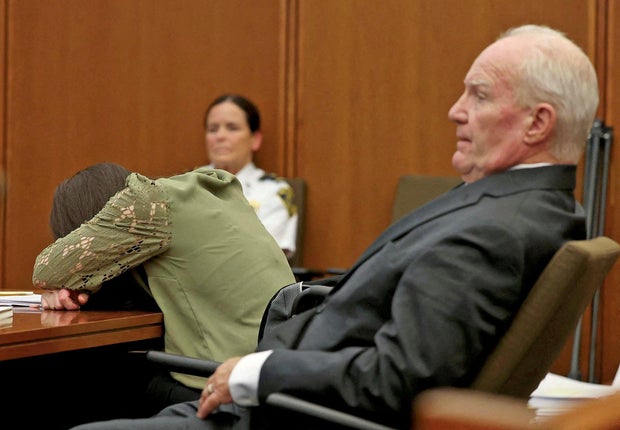
The outburst was Clancy’s second of the day following an earlier disruption when she cried with her head in her hands. Judge William Sullivan sent the jury out of the courtroom each time.
After the first recess, Sullivan spoke to the jury and reminded them that they took an oath to follow the law.
“I’m instructing you that the law says you must separate any emotional reaction on your part from the informational value and weight that the evidence produces,” he said.
Lindsay Clancy’s psychiatrist testifies about treatment
Psychiatrist Dr. Jennifer Tufts had 14 telehealth appointments with Clancy over a period of about four months, with the last on the day before the killings. She said that Clancy never seemed psychotic.
When Reddington asked if Tufts knew that Clancy told her then-husband she was having thoughts of harming the children, Tufts testified on Aug. 10 that she didn’t and that she would be very concerned if she did.
Tufts said Clancy told her she felt numb and couldn’t sleep.
“She denied feeling suicidal, but that she was close to feeling suicidal,” Tufts said.
While being questioned by prosecutors, Tufts testified that Clancy tried at least 10 medications in search of the right combination to try and stop her anxiety and depression. Tufts also said Clancy blamed the drugs for her condition and was reluctant to take them.
Tufts prescribed Clancy the antidepressant Zoloft, which has a warning that it and other antidepressants may increase suicidal thoughts or actions in some people aged 24 and younger.
“I don’t believe there’s evidence that it causes that at all in individuals over 24,” Tufts told Reddington.
If you or someone you know is in emotional distress or a suicidal crisis, you can reach the 988 Suicide & Crisis Lifeline by calling or texting 988. You can also chat with the 988 Suicide & Crisis Lifeline here.
For more information about mental health care resources and support, the National Alliance on Mental Illness (NAMI) HelpLine can be reached Monday through Friday, 10 a.m. to 10 p.m. ET, at 1-800-950-NAMI (6264) or email info@nami.org.
Breaking News, World News, US News, Sports
Source link


